



Hello Mr Duckbill, could you tell us more about the person behind this pseudonym?
Behind Mr. Duckbill there is an Italian creative with more than twenty years of experience in visual communication, graphic design and image-making. I have worked for a long time with logos, packaging, visual identities, social media and communication projects, but in parallel I have always developed a personal artistic research.
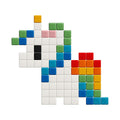
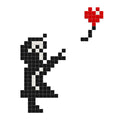
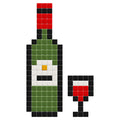
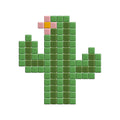
Over the years, I have experimented mainly with painting, stencil art, pop culture, urban icons and strong graphic images. More recently, this research has moved towards pixel art and mosaic, finding a new form in the Rabbit Project: small white rabbits built tile by tile and made to appear in the urban space.
I am very interested in the border between art, communication, design and the street. I do not see these as separate worlds: for me, they are part of the same visual language.
And about the choice of this pseudonym?
Mr. Duckbill was born as a slightly instinctive, ironic and surreal artist name. I was looking for an identity that was not too serious, not too “artist-like”, but something strange, memorable and slightly out of place.
“Duckbill” refers to a duck’s beak, but also to the platypus: a hybrid, almost impossible animal, made of elements that seem as if they should not belong together, and yet somehow work. In a way, this represents me quite well. My work often comes from contaminations too: painting and graphics, manual work and digital language, street art and design, pop culture and everyday observation.
I liked the idea of a name that does not explain everything, but opens a small question.

What was your first encounter with urban art?
My first real encounter with urban art probably happened through walls, more than through museums. I grew up observing graffiti, stencils, stickers, writings and anonymous signs left in public space. I have always been fascinated by the idea that an image can suddenly appear in an unexpected place and change the way you look at that street, that corner or that wall.
Later, I discovered artists such as Banksy, Invader, Shepard Fairey, Mr. Brainwash and many others, but what has always interested me the most is not only the street aesthetic. It is the possibility of creating a small short circuit in everyday life. A small image in the right place can generate curiosity, a smile, a doubt, a conversation.
I think the Rabbit Project comes exactly from there: from the desire to make something small but recognizable appear in the city, something able to inhabit the urban space without shouting.

If you had to define your style in three words, what would they be?
Pixel, urban, poetic.
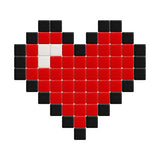
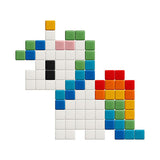
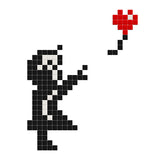
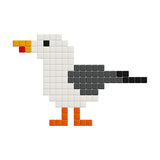
Pixel, because my current language is built from minimal units: tiles, modules, fragments, small elements that together create an image.
Urban, because the relationship with the street and public space is central to my work.
Poetic, because even if I use a very graphic and immediate language, I am interested in creating small apparitions capable of generating imagination, tenderness, mystery and storytelling.

What are your main sources of inspiration?
Animated series, the work of other people, vivid memories from life.
My inspirations come from many different worlds. Certainly pop culture, cartoons, video games, graphic design, pixel art, icons from the 80s and 90s, but also urban art and contemporary design.
Among the artists who have influenced me, Invader is certainly important, for his relationship between mosaic, pixel and the city. Banksy too, for his ability to use simple images with great narrative power. But I am also inspired by artists connected to pop culture, stencil art, sculpture and urban imagination.
I am also very inspired by the details of everyday life: a forgotten corner, a crack, a damaged wall, a niche, a sign, a threshold. Often I do not start only from the subject, but from the place where it could appear. In this sense, the rabbit becomes a small presence that highlights something that was already there, but perhaps nobody was looking at.

Could you tell us about your first mosaic, from idea to installation?
The first mosaic came from a very simple idea: transforming a digital drawing into a small physical object, made by hand. I wanted to take the logic of the pixel out of the screen and make it concrete, material, almost fragile.
I started with a small white rabbit, built on a very essential grid. Each tile corresponded to a pixel. The most interesting part was realizing that, once translated into mosaic, the drawing changed its nature. It was no longer just an image, but a small object, with weight, thickness, reflections and imperfections.
The installation was just as important. Placing the first rabbit in the urban space meant testing it: understanding whether it really worked outside the worktable, whether it could dialogue with a wall, a corner, a street. When I saw that the small rabbit seemed to belong to that place, I understood that the project could grow.

What cities and countries have you visited?
I live and work in Piedmont, in northern Italy, so many of my urban explorations start from Turin, Chieri, Monferrato, the Langhe and other places in this area. Turin in particular is a very important city for me: it has an elegant, industrial and mysterious soul, full of walls, courtyards, passages and hidden details.
I have visited several Italian and European cities like Berlin, Prague, Paris…and every time I realize that I look at them more as possible visual maps than as simple tourist destinations. I am interested in traces, margins, side walls, less obvious neighborhoods, places where the city seems to tell something without declaring it.
In the future, I would like to bring the rabbits outside Italy too, making them appear in different cities as small recognizable presences, but always adapted to the local context.
What is your favorite mosaic?
At the moment, my favorite mosaic is not necessarily the most complex or the largest one. It is one of the small urban rabbits, because it represents the spirit of the project very well: a minimal, almost silent work that is still able to create a reaction.
I especially like the pieces where the rabbit is not simply “posing”, but doing a small action: observing something, pointing to a detail, looking at a picture, guarding a corner. In those cases, the mosaic almost becomes a scene, a micro-narrative.
I think my favorite mosaic changes often, because each rabbit truly works only when it meets the right place.

Do you have a bad experience that you could tell us about?
Yes, some installations have been removed or stolen. At first, this can be frustrating, because each piece requires time, manual work and care. But it is also part of the nature of the project: when you bring something into public space, you accept that it is no longer completely under your control.
In a way, this too becomes part of the story. A rabbit can stay, disappear, be photographed before disappearing, become a topic of conversation. The city is not a protected gallery: it is alive, unpredictable, sometimes kind and sometimes brutal.
This experience has taught me to think of every installation as a small temporary apparition, even when I hope it will stay there for a long time.
What are your artistic projects and desires for this year?
This year I would like to consolidate the Rabbit Project and develop it on several levels.
The first level is urban: continuing to make rabbits appear in public space, creating small paths of discovery.
The second level is original works: mosaics on supports, plexiglass, panels and wall pieces, also conceived for collectors, galleries and interior spaces.
The third level is limited editions: prints, small multiples and objects that can make the project accessible without losing quality and identity.
I am also working on the possibility of developing larger site-specific installations, where the rabbit becomes a main presence, almost a “guest star” of the path.
My most concrete desire is to give the project a stronger structure: website, portfolio, shop, collaborations and exhibition opportunities.

Your wildest dream?
My wildest dream would be to see the Rabbit Project become a small international map: white rabbits appearing in different cities and countries, each one connected to the place where it is installed.
I would like the rabbit to become a recognizable character, but not in a banal commercial way. A figure that people look for, photograph, follow, almost like a small urban legend.
And then I dream of a large intervention: a huge rabbit built with modules, tiles or panels, visible from far away or from above. Something that starts from a tiny image and becomes monumental.
Small bits. Big rabbit.
And finally, which artist would you like me to interview for the next portrait?
I would really like to read an interview with Florist — @florist.ldn.
I feel his work is very close to the spirit of street mosaic art: urban interventions, repetition, recognizability and a direct relationship with the city. I really like how his mosaics seem to inhabit public space, turning walls, corners and everyday surfaces into small moments of discovery.
I think he would be a very interesting artist to interview, especially for anyone interested in the connection between mosaic, street art and contemporary urban imagery.
How can we subscribe to you?
You can follow the project on Instagram:
Instagram: @mr_duckbill_art
The website and shop are currently under development. For now, Instagram is the main place to follow the evolution of the Rabbit Project, new installations, mosaic works and upcoming developments.